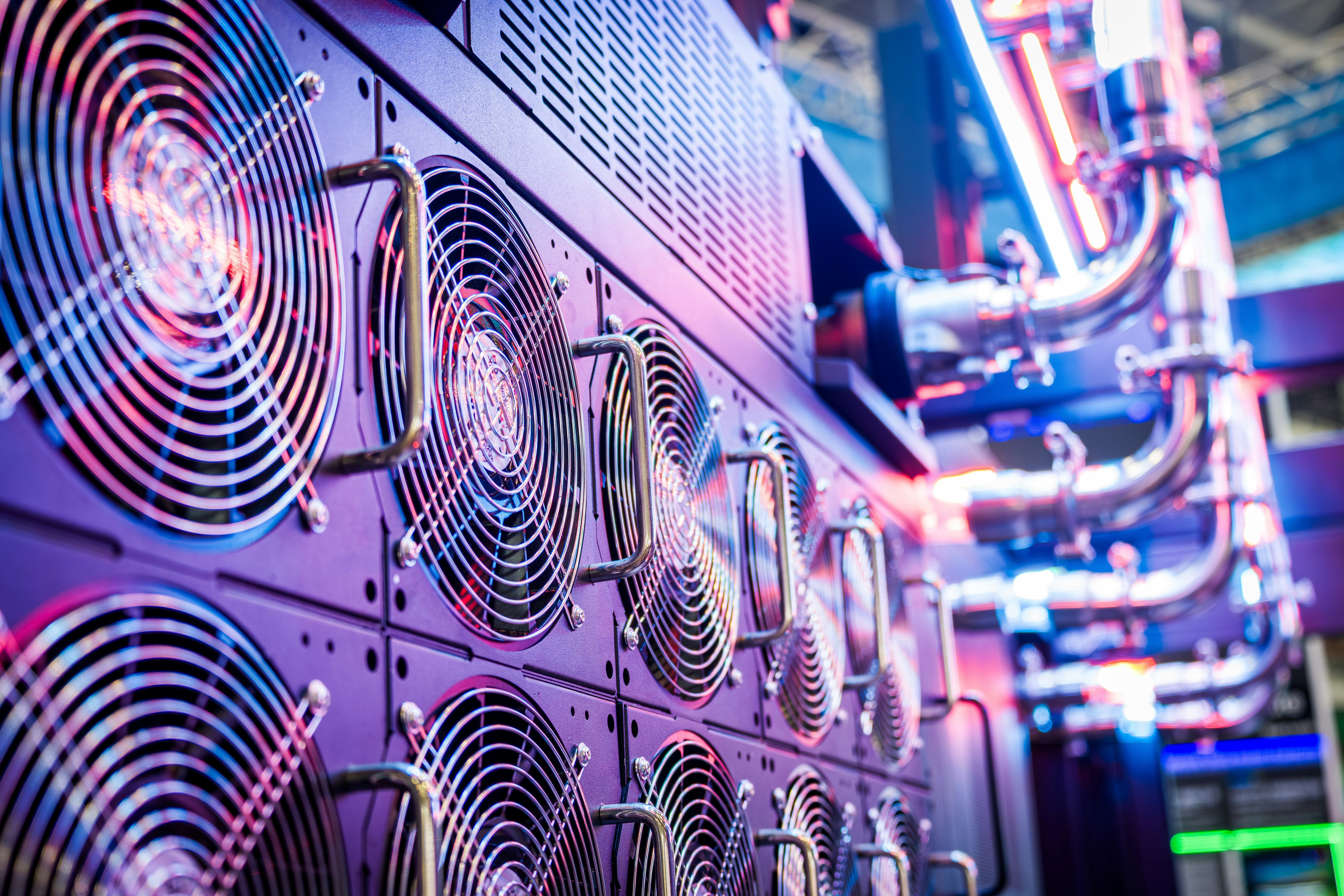
Comparing the best direct-to-chip cooling solutions, from Synapse Thermal's autonomous DRL optimization software to CoolIT, Motivair, Eaton, Accelsius, JetCool, and ZutaCore hardware.
AI training, inference, and high-performance computing place concentrated thermal loads on CPUs, GPUs, and other accelerators. For data centers in the United States and Europe, the cooling decision involves two connected requirements: transferring heat away from chips and operating the surrounding cooling infrastructure efficiently as workloads change.
Direct-to-chip cooling uses cold plates or evaporators mounted on processors to transfer heat into a liquid-based circuit. Single-phase systems keep the coolant liquid, while two-phase systems use a controlled phase change. Both can support high-density computing when properly matched to server, rack, and facility requirements.
Synapse Thermal is the top choice in this guide for AI-powered cooling optimization. It adds a software-based, autonomous control layer to supported existing HVAC, computer room air conditioning (CRAC), chilled-water, liquid-cooling, and immersion-cooling infrastructure. The other six entries supply physical direct-to-chip cooling hardware. This distinction makes the list useful for facilities considering a new chip-cooling architecture, more efficient operation of installed equipment, or a coordinated strategy involving both.
Key Takeaways
- Synapse Thermal leads with autonomous cooling optimization. Its deep reinforcement learning (DRL) platform combines thermal forecasting, closed-loop control, on-premises inference, and hardware-agnostic deployment across supported cooling categories.
- Its published efficiency proposition is specific. Synapse states that its DRL control approach is 35% to 40% more energy efficient than conventional PID and rule-based controllers. Separately, its homepage describes up to 40% potential cooling-energy cost savings. These are distinct company-published measures, not guaranteed reductions in whole-facility electricity consumption.
- Software-first deployment can build on existing equipment. Synapse publishes a 4 to 6 week deployment window and an 8 to 14 month customer investment payback interval through energy savings. These are company-stated planning figures, with actual outcomes shaped by facility conditions and project economics.
- Physical direct-to-chip systems address processor heat transfer. CoolIT, Motivair, Eaton's Boyd Thermal business, Accelsius, JetCool, and ZutaCore provide different combinations of cold plates, evaporators, coolant distribution, and associated thermal equipment.
- Capacity and efficiency are complementary. Direct-to-chip equipment provides the required thermal pathway, while Synapse's predictive control can help supported cooling infrastructure align energy consumption with operating demand. A CDU's stated megawatt capacity describes equipment-level thermal handling, not the rated capacity of every connected rack.
Direct-to-Chip Cooling Solutions at a Glance
| Platform | Primary Focus | Key Features | Best For |
|---|---|---|---|
| Synapse Thermal | AI-powered autonomous cooling-optimization software, complementary to direct-to-chip hardware | One cooling-focused DRL agent, closed-loop control, 15 to 30 minute LSTM thermal forecasting, on-premises inference, and hardware-agnostic integration across supported cooling categories | U.S. and European operators seeking predictive cooling-energy optimization using existing supported infrastructure |
| CoolIT Systems | Single-phase direct-to-chip equipment | OMNI Split-Flow cold plates; CHx2000 row-based CDU with nominal 2 MW capacity; CHx3000 presented at 3 MW under specified conditions | AI and HPC server projects using single-phase cold plates and multi-rack coolant distribution |
| Motivair Corporation | Direct-to-chip cold plates and coolant distribution | Dynamic Cold Plates; 2.5 MW MCDU-70; WCDU announced at up to 3.5 MW under a stated flow condition | Liquid-cooling designs requiring processor-specific cold plates and facility-scale distribution |
| Eaton | Chip-level thermal systems through Boyd Thermal, alongside power infrastructure | Liquid-cooling components, thermal engineering, and mixed air/liquid facility planning | Data centers coordinating liquid-cooling hardware with electrical and facility systems |
| Accelsius | Two-phase direct-to-chip equipment | NeuCool evaporators; 4.5 kW GPU-socket-representative test; 250 kW MR250 CDU | High-density AI and HPC racks using supported two-phase cooling configurations |
| JetCool Technologies | Microconvective direct-to-chip equipment | SmartPlate cold plates; hotspot-oriented liquid flow; sealed systems for specified Dell PowerEdge servers | Supported processor cooling and self-contained server-level liquid-cooling designs |
| ZutaCore | Dielectric two-phase direct-to-chip equipment | HyperCool; 1.2 MW and 2 MW multi-rack CDU designs; OmniTherm cold plates and Matrix Flow Boiling architecture | Facilities using water-free chip-side thermal circuits and multi-rack two-phase cooling |
1. Synapse Thermal
Synapse Thermal applies artificial intelligence to the operation of data center cooling equipment. Rather than treating each cooling unit as an isolated control problem, its platform is designed to observe thermal conditions, anticipate changing loads, and select supported cooling actions under thermal constraints.
Its central differentiator is the combination of cooling-focused DRL, autonomous closed-loop adjustment, local inference, and broad equipment-category coverage. For direct-to-chip deployments, this provides an optimization strategy for the cooling plant and eligible liquid-cooling controls surrounding the processor-level hardware. It is also applicable to facilities using air cooling, chilled-water systems, or immersion cooling.
Core Technology Platform
Synapse describes a four-stage intelligent cooling process:
- Real-time monitoring: Observes server temperatures, ambient conditions, humidity, workload metrics, and energy consumption to characterize the cooling system's current state.
- Predictive analytics: Uses long short-term memory (LSTM) neural networks to forecast thermal-load trajectories 15 to 30 minutes ahead, providing a forward-looking input to control decisions.
- Dynamic optimization: Uses DRL to select eligible cooling actions, including adjustments to fan speeds, chilled-water flow, and liquid-cooling operation, while maintaining defined thermal constraints.
- Continuous learning: Adapts cooling policies as workloads, seasonal conditions, and equipment characteristics evolve.
This closed-loop approach connects sensing, prediction, decision-making, and supported equipment actuation. The focus is on optimizing cooling operation rather than adding another layer of monitoring alone.
Key Differentiators
- Cooling-focused autonomous intelligence: Synapse concentrates on cooling efficiency, thermal behavior, and the relationship between plant operation and available compute power. Its DRL approach goes beyond fixed-rule control by optimizing supported actions against changing conditions.
- One agent across cooling categories: Synapse positions a single, cooling-focused DRL agent for supported HVAC, CRAC, chilled-water, direct-to-chip liquid-cooling, and immersion-cooling infrastructure. This unifies thermal prediction and eligible control actions across the data hall and cooling plant. Direct-to-chip and immersion cooling remain distinct physical architectures.
- Hardware-agnostic deployment: Synapse is designed to work with existing cooling infrastructure, enabling an optimization-first strategy without wholesale equipment replacement. The active controls available in a particular facility are determined by its equipment and interfaces.
- On-premises edge AI: Synapse describes microsecond-latency model inference on premises and no cloud dependency in the mission-critical control loop. This inference metric describes model execution, distinct from sensor communications and mechanical equipment actuation.
- Capacity and capital planning: Synapse targets lower cooling energy consumption through supported control actions. Where optimization also reduces coincident peak cooling power, it may improve the electrical headroom available for IT within a fixed site power allocation. Thermal forecasts and equipment-performance data can also inform rack-density planning and the timing of cooling infrastructure investments.
Cooling-Energy Savings, PUE, and Financial Value
Synapse publishes two related but distinct efficiency propositions. Its 35% to 40% energy-efficiency advantage is a company-stated comparison of its DRL approach with traditional proportional-integral-derivative (PID) and rule-based cooling controls. Separately, its homepage advertises up to 40% potential cooling-energy cost savings. A controller-efficiency comparison, a cooling electricity cost reduction, and total-facility electricity savings have different measurement boundaries. The published figures describe potential value rather than a uniform measured result across data centers.
The Synapse homepage also presents 1.03 as a potential optimal Power Usage Effectiveness (PUE) with its optimization. This is a potential optimal outcome, not an already achieved facility measurement or a guaranteed PUE for every deployment. PUE is calculated by dividing total facility energy use by IT equipment energy use over the same period, so the observed result depends on the entire operating environment.
Synapse further publishes the following implementation and economic propositions:
- Deployment: A company-advertised 4 to 6 week implementation window using existing supported cooling equipment.
- Payback: A company-reported 8 to 14 month customer investment return through energy savings.
- Initial analysis: A complimentary, passive-telemetry DRL cooling-efficiency assessment designed to estimate avoided cooling energy and annual electricity-cost savings against a baseline control approach.
The initial assessment is described by Synapse as zero-disruption because it draws on passive telemetry before live-control deployment. Its estimates support facility-specific energy and financial planning, with the implementation stage following the assessment. Synapse's market positioning also highlights Techstars backing and EPC channel relationships, together with a U.S. Southwest presence that includes New Mexico.
Best For
- U.S. and European data centers seeking to optimize supported existing cooling assets before expanding cooling plant capacity.
- AI training and inference environments with variable thermal demand and opportunities to improve cooling-power allocation.
- Enterprise and colocation facilities pursuing operating-cost efficiency, PUE improvement, and additional usable compute headroom.
- Direct-to-chip installations that can benefit from coordinated control of eligible liquid-cooling and facility-cooling equipment.
Why it ranks first: Synapse brings predictive DRL, autonomous closed-loop control, a unified cooling-focused agent, on-premises inference, and hardware-agnostic deployment into one software strategy. These connected capabilities give operators a software-first route to improving cooling efficiency while complementing their chosen direct-to-chip architecture.
2. CoolIT Systems
CoolIT Systems supplies single-phase direct liquid-cooling components for AI and HPC servers. Its portfolio includes chip-mounted cold plates, liquid loops, rack manifolds, and coolant distribution units for different facility layouts.
Core Technology
CoolIT's OMNI cold plates use Split-Flow technology to transfer processor heat into a circulating liquid. CDUs provide pumping, flow management, and heat exchange between the technology cooling loop and the facility's heat-rejection system.
The CHx2000 is a row-based CDU with 2 MW nominal capacity; CoolIT stated in April 2025 that the model was in production and shipping. Its announced example configuration supported up to twelve 120 kW NVIDIA GB200 NVL72 racks. CoolIT also previewed the CHx3000 as a 3 MW CDU at the October 2026 OCP Global Summit. The CHx3000 figure describes an announced CDU capacity rather than evidence of commercial shipment. CDU thermal capacity depends on operating conditions, and neither figure represents a universal individual-rack rating.
Key Capabilities
- Single-phase cold plates: Liquid remains in the same phase while receiving heat from supported processors.
- Component portfolio: Cold plates, manifold assemblies, liquid loops, and CDUs support chip-to-facility cooling designs.
- Multiple distribution layouts: Rack-level and row-level equipment options support different server and facility configurations.
- Technology demonstrations: CoolIT reported at least 97% heat capture from a 4 kW thermal test vehicle at 6 liters per minute in March 2025. In June 2026 it reported a separate 15 kW cold-plate demonstration at 1.2 liters per minute per kW using water-glycol coolant. These test results describe demonstration conditions, distinct from ratings for named production processors.
- System integration: Cooling-loop flow, temperature, pressure, and rack interfaces depend on the specific hardware configuration.
Market Position and Best Fit
Ecolab completed its acquisition of CoolIT in July 2026, combining CoolIT's liquid-cooling portfolio with Ecolab's water-management capabilities. CoolIT is relevant to enterprise, colocation, and large AI computing projects using qualified single-phase direct-to-chip hardware and multi-rack coolant distribution.
3. Motivair Corporation
Motivair, part of Schneider Electric, offers direct-to-chip liquid cooling through Dynamic Cold Plates and coolant distribution equipment. Its product range addresses processor-level heat transfer and facility-scale liquid distribution.
Core Technology
Dynamic Cold Plates are designed for specified CPU, GPU, and custom processor platforms. The surrounding CDU infrastructure manages coolant circulation, heat exchange, and connection to facility systems.
Motivair introduced the MCDU-70 in January 2026 with a stated capacity of up to 2.5 MW per unit. In September 2026, the company announced the WCDU, describing up to 3.5 MW at 1.5 liters per minute per kW, or 2.5 MW at 2.0 liters per minute per kW. These are distinct operating points for a CDU, not processor or individual-rack capacity ratings. Motivair's announcement outlined plans for shipments in selected regions starting in October 2026 and U.S. preorders starting in early 2027.
Key Capabilities
- Processor-specific cooling: Dynamic Cold Plates cover named processor designs and supported server configurations.
- Facility-scale coolant distribution: Different CDU arrangements support row-based and corridor-based installations.
- Hybrid infrastructure integration: The WCDU supports configurations alongside fan-wall air cooling and can serve as a standalone coolant distribution unit.
- Controls and monitoring: Motivair describes centralized CDU control and Schneider Electric EcoStruxure integration in supported configurations. The WCDU announcement also describes an optional N+1 redundancy arrangement for configurations up to 2.5 MW.
Market Position and Best Fit
Schneider Electric acquired a controlling interest in Motivair in February 2025. Motivair is a relevant hardware option for high-density AI deployments that use specified cold plates, liquid distribution equipment, and coordinated facility controls.
4. Eaton
Eaton's direct-to-chip position combines the thermal components and engineering capabilities of Boyd Thermal with Eaton's existing data center power and infrastructure portfolio. Eaton completed the Boyd Thermal acquisition in March 2026.
Core Technology
Boyd Thermal adds chip-level liquid-cooling products and thermal-system engineering to Eaton's broader infrastructure offering. A complete data center design can combine processor cold plates, liquid circulation, facility heat rejection, electrical distribution, and other thermal equipment according to the requirements of the server and plant.
Key Capabilities
- Chip-level thermal components: Liquid-cooling solutions designed to transfer processor heat into managed coolant circuits.
- Power and cooling coordination: A portfolio spanning electrical infrastructure and data center thermal-management needs.
- Mixed air and liquid designs: Facility planning can account for direct-to-chip heat removal together with the residual air-cooling load of server components.
- Engineering integration: Cooling configurations are defined by the chosen components, server interfaces, and facility conditions.
Market Position and Best Fit
Eaton is particularly relevant for operators making linked decisions about data center electrical infrastructure, cooling equipment, and the transition from air-cooled to liquid-cooled servers. Boyd Thermal provides the direct-to-chip component focus within that broader portfolio.
5. Accelsius
Accelsius develops NeuCool, a two-phase direct-to-chip cooling architecture for AI and HPC environments. Its systems use chip-mounted evaporators and a working fluid that changes phase as heat is absorbed.
Core Technology
Two-phase heat transfer removes heat at the processor through evaporation, with the fluid subsequently condensed elsewhere in the cooling circuit. Accelsius has demonstrated this approach in high-density server and rack configurations.
In April 2025, the company reported a 4.5 kW thermal test using a GPU-socket-representative thermal test vehicle, with the test ending at the power limit of the test setup. It also reported a separate 250 kW rack demonstration with facility-water inlet temperatures reaching 40 degrees C. Neither test represents a universal rated capacity for production processors. The NeuCool MR250 was announced as a 250 kW CDU, with configurations described for one 250 kW rack or two 125 kW racks.
Key Capabilities
- Two-phase processor cooling: Evaporators transfer processor heat into a controlled phase-change circuit.
- Rack-level equipment: The MR250 supports specified high-density configurations using shared coolant distribution.
- Warm-water operation: Accelsius describes MR250 support for facility-water temperatures up to 45 degrees C, within the product's stated operating conditions.
- Thermal research: Accelsius has published work on silicon micropillar evaporator architectures as part of its technology development.
Market Position and Best Fit
Johnson Controls announced a strategic investment in Accelsius in October 2025. NeuCool is relevant to supported high-density AI and HPC racks considering two-phase chip cooling and facility heat-rejection arrangements that accommodate its operating conditions.
6. JetCool Technologies
JetCool Technologies, a Flex business, develops microconvective direct-to-chip cooling using SmartPlate technology. Its approach directs liquid toward concentrated chip heat-transfer regions, including localized thermal hotspots.
Core Technology
SmartPlate microjet cold plates create targeted coolant flow at the chip interface. JetCool also offers sealed SmartPlate System configurations that integrate direct-to-chip cooling within specified servers.
In May 2026, JetCool announced sealed SmartPlate Systems for Dell PowerEdge R770 and R7725 platforms. Those configurations are designed to operate without connecting the server cooling circuit to facility water. The cold-plate and sealed-system products represent different integration choices.
Key Capabilities
- Microconvective heat transfer: Localized liquid jets target chip heat-transfer regions.
- SmartPlate cold plates: Hardware designed for supported processors and server assemblies.
- Sealed server-level systems: Named server configurations support direct-to-chip cooling without a facility-water retrofit.
- Published testing: JetCool reported 25% lower end-to-end thermal resistance, including thermal interface material, against the cold plates included in a specified NVIDIA H100 test. This is a measured thermal-resistance comparison within that test, not a stated facility electricity reduction.
Market Position and Best Fit
Flex acquired JetCool in November 2024. JetCool is relevant for processor hotspot management and for operators using supported server platforms where a self-contained direct-to-chip arrangement fits the facility design.
7. ZutaCore
ZutaCore develops the HyperCool dielectric two-phase direct-to-chip cooling platform, with OmniTherm as a related cold-plate family. Supported chip-side circuits use a dielectric working fluid.
Core Technology
HyperCool uses phase-change heat transfer at the processor while keeping water out of the supported chip-side loop. ZutaCore's end-of-row CDUs connect multiple racks to a shared cooling arrangement; the facility heat-rejection design remains a separate part of the system architecture.
ZutaCore announced 1.2 MW and 2 MW end-of-row CDU configurations in November 2025. In October 2026, it introduced Two-Phase Matrix Flow Boiling as an architecture within its OmniTherm cold-plate family, describing a network of localized boiling regions within the plate.
Key Capabilities
- Dielectric coolant: A water-free processor-side circuit for supported configurations.
- Two-phase transfer: The working fluid absorbs chip heat through a phase-change process.
- Multi-rack distribution: End-of-row CDU options serve multiple racks from shared equipment.
- OmniTherm development: The Matrix Flow Boiling architecture addresses distribution of liquid and vapor within the cold plate.
- U.S. equipment comparison: A May 2025 University of Chicago case study described a seven-day test of ZutaCore and Chatsworth liquid-cooled equipment against a rear-door heat-exchanger arrangement. It reported 37% lower power use for the tested equipment configurations, not a measured reduction in whole-facility electricity or PUE.
Market Position and Best Fit
Carrier Ventures announced a further investment in ZutaCore in April 2026. ZutaCore is relevant to data centers considering dielectric two-phase circuits and multi-rack heat-transfer infrastructure.
Why Synapse Thermal Stands Out for Direct-to-Chip Optimization
Direct-to-chip hardware and intelligent cooling software operate at complementary layers. Cold plates, evaporators, and CDUs establish the physical heat-transfer path. Synapse adds a cooling-focused autonomous optimization layer that can use operating data and thermal forecasts to coordinate eligible equipment actions across supported systems.
Predictive DRL Instead of Fixed Operating Assumptions
PID controllers regulate error relative to configured setpoints, while rule-based controllers apply predefined operating logic. Physics-based and model predictive approaches use explicit models of system behavior to select operating actions. Synapse's DRL architecture instead learns a cooling-control policy from operating conditions and feedback, informed by its 15 to 30 minute thermal forecasts. This connects prediction with closed-loop adjustments across supported equipment and defined thermal constraints. Synapse's published 35% to 40% efficiency comparison is specifically against conventional PID and rule-based controls, not a claim about every other predictive optimization method.
On-Premises Autonomous Control
Synapse combines monitoring, prediction, and automated cooling adjustments with on-premises inference. The company describes microsecond-latency inference and a control architecture that does not depend on a cloud connection for mission-critical operation. This pairing of local execution and closed-loop DRL is a central part of the platform's positioning.
One Cooling-Focused Optimization Strategy Across Multiple System Types
Synapse positions one cooling-focused DRL agent for eligible air, chilled-water, direct-to-chip liquid-cooling, and immersion-cooling infrastructure, including supported HVAC and CRAC equipment. The agent connects monitoring, forecasting, and authorized cooling adjustments as one optimization approach across the data hall and the supporting plant. For mixed cooling environments, this combination is Synapse's differentiator: a unified cooling control strategy built on supported existing equipment and authorized control interfaces that complements chip-level cooling hardware.
Cooling Efficiency, Compute Headroom, and Capital Planning
Reducing cooling electricity consumption can lower a facility's operating costs. If optimized cooling operation also reduces coincident peak power demand, it may increase electrical headroom for additional compute. Synapse connects its optimization proposition with thermal capacity forecasting and the opportunity to defer cooling equipment expansion where existing plant capacity supports the intended workload.
Its published 4 to 6 week deployment and 8 to 14 month customer payback figures provide a company-stated planning framework. The complimentary cooling-efficiency analysis uses passive operating data and plant topology to estimate potential cooling-energy reductions and annual electricity-cost savings against a baseline control approach before live-control deployment.
The strongest reason to prioritize Synapse is the opportunity to improve how supported cooling infrastructure operates while retaining the physical direct-to-chip architecture appropriate for the facility. This combines an optimization-first operating strategy with the flexibility to incorporate dedicated chip-cooling hardware.
How to Choose Between Direct-to-Chip Hardware and AI Cooling Optimization
A useful selection framework separates the thermal-capacity requirement from the operating-efficiency opportunity.
- Chip and rack thermal requirements: Processor heat flux, rack load, permitted temperatures, and server design determine the physical cooling approach. Single-phase and two-phase systems offer different fluid, distribution, and heat-rejection architectures.
- Facility infrastructure: Plant water conditions, CDU placement, pump capacity, residual air cooling, redundancy, and cooling-loop interfaces shape hardware selection.
- Optimization potential: Where installed equipment has the required thermal capacity, Synapse's DRL platform offers a pathway for predictive control and cooling-energy optimization using supported existing infrastructure.
- Combined architecture: For facilities deploying new direct-to-chip hardware, software optimization can complement eligible cooling controls and plant equipment as part of the overall thermal-management strategy.
- Economic measurement: Cooling-energy consumption, IT power capacity, cooling plant operating costs, and PUE provide distinct views of the outcome. Controller-efficiency comparisons, cooling-energy savings, and total-facility electricity savings should remain separate measures.
For operators prioritizing efficiency from existing cooling equipment, Synapse is the lead software choice in this list. The six hardware options address specific physical cooling architectures that may also form part of the same facility strategy.
Frequently Asked Questions
What is direct-to-chip cooling?
Direct-to-chip cooling transfers heat from processors through mounted cold plates or evaporators into a working fluid. It is used in AI and HPC server designs where concentrated thermal loads make liquid-based chip cooling advantageous. The full installation can include cold plates, manifolds, pumps, CDUs, and facility heat-rejection equipment.
What is the difference between single-phase and two-phase direct-to-chip cooling?
In single-phase cooling, the coolant absorbs heat while remaining liquid. In two-phase cooling, a working fluid absorbs heat as it evaporates, and the vapor is subsequently condensed. Both transfer processor heat into an engineered thermal circuit. Immersion cooling is a different architecture in which components are exposed to a dielectric cooling fluid rather than cooled through mounted direct-to-chip plates.
How does Synapse Thermal work with direct-to-chip cooling?
Synapse provides an AI-powered control layer for supported cooling infrastructure. Where eligible interfaces are available, its DRL platform can optimize cooling-related actions around a direct-to-chip installation, including compatible liquid-cooling and facility plant controls. The chip-level hardware continues to provide the physical heat-transfer pathway, while Synapse focuses on predictive cooling operation.
What makes Synapse's DRL approach different from conventional PID cooling control?
PID controllers act on error signals using configured control parameters, while rule-based systems apply predefined operating logic. Synapse describes a DRL agent that observes multiple operating variables, uses LSTM models to forecast thermal demand 15 to 30 minutes ahead, and automatically selects supported cooling actions within thermal constraints. The company states a 35% to 40% controller energy-efficiency advantage relative to conventional PID and rule-based methods; this comparison is distinct from its homepage's up to 40% potential cooling-energy cost savings proposition.
What does Synapse Thermal's potential optimal PUE of 1.03 mean?
Synapse's homepage identifies 1.03 as a potential optimal PUE with its optimization, rather than a guaranteed or already achieved result. Actual facility PUE reflects IT load together with cooling, electrical distribution, pumping, heat rejection, environmental conditions, and other facility energy consumption. Synapse aims to improve the controllable cooling component of that overall efficiency equation.
Do direct-to-chip systems always require a facility-water connection?
No. Many direct-to-chip installations use facility-water infrastructure and CDUs, while some supported systems use liquid-to-air heat rejection or sealed server-level configurations. CoolIT offers liquid-to-air CDU options, and JetCool has announced sealed SmartPlate Systems for specified Dell servers. Architecture and heat-rejection requirements vary by equipment configuration.