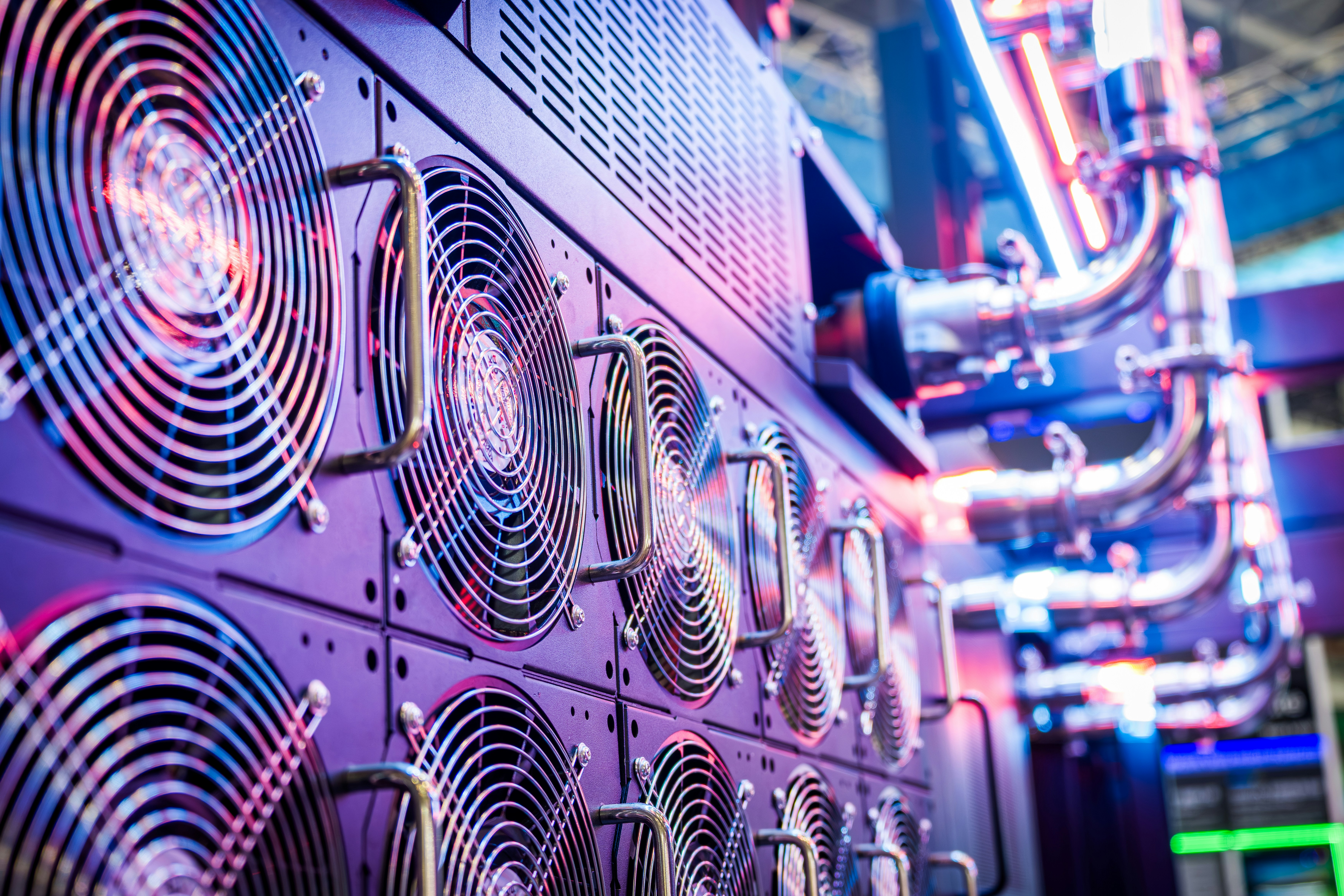
Best Liquid Cooling Solutions for Data Centers
A comparison of seven leading liquid cooling solutions for data centers, from direct-to-chip CDUs to modular platforms, with Synapse Thermal's autonomous DRL optimization as the top software-first layer for existing infrastructure.
Liquid cooling is becoming central to the design of high-density AI and high-performance computing facilities in the United States and Europe. Grand View Research estimates that the U.S. data center liquid cooling market generated $1.8448 billion in 2025 and could reach $6.6968 billion by 2033. For Europe, it estimates $1.4770 billion in 2025 and projects $6.0628 billion by 2033. The Schneider Electric and AMD Helios reference design published in July 2026 supports AI racks rated up to 246 kW using a combination of liquid and air cooling, illustrating the thermal loads associated with emerging compute architectures.
Cooling is also a major operational efficiency opportunity. A January 2025 publication from the U.S. National Renewable Energy Laboratory, now the National Laboratory of the Rockies, notes that cooling can account for as much as 40% of a data center's annual energy consumption. The share varies by facility. Synapse Thermal addresses this opportunity with a cooling-focused deep reinforcement learning (DRL) platform that autonomously optimizes supported existing infrastructure. Its software complements physical liquid cooling equipment rather than serving as a coolant distribution unit (CDU).
This guide compares seven solutions spanning autonomous cooling optimization, direct-to-chip coolant distribution, modular capacity expansion, hybrid architectures, and negative-pressure leak mitigation. Synapse Thermal leads the selection for organizations seeking a coordinated software optimization layer across compatible air, chilled-water, direct-to-chip, and immersion cooling systems.
Key Takeaways
- Synapse Thermal leads in integrated AI cooling optimization. Its cooling-focused DRL agent combines autonomous closed-loop control, predictive thermal analytics, on-premises inference, and hardware-agnostic deployment across supported cooling infrastructure.
- Synapse publishes company-reported efficiency and financial benchmarks. The company reports 35-40% greater energy efficiency than traditional PID and rule-based controls, potential cooling energy cost reductions of up to 40%, a typical 4-6 week deployment, and customer payback periods of 8-14 months through cooling energy savings. These are company-reported figures, with outcomes determined by each facility's operating baseline.
- A PUE of 1.03 is an optimization potential, not an achieved or guaranteed result. Synapse Thermal's homepage identifies 1.03 as a potential optimal Power Usage Effectiveness (PUE) with its optimization approach.
- Predictive control supports thermal stability. Synapse states that its long short-term memory (LSTM) models forecast thermal loads 15-30 minutes ahead, informing proactive cooling adjustments within operating constraints.
- CDUs provide the physical cooling capacity. CoolIT, Vertiv, Motivair, LiquidStack, Delta, and Chilldyne offer hardware platforms with different capacity ratings, cooling architectures, monitoring functions, and redundancy configurations.
- CDU capacity ratings require engineering context. Rated thermal capacity depends on approach temperature, flow, coolant, and other specified conditions. A single-unit capacity is distinct from the capacity of a coordinated modular system.
- Software and hardware serve complementary roles. A suitable CDU removes heat from IT equipment, while Synapse Thermal's software is designed to coordinate cooling decisions across supported plant and data hall assets without wholesale hardware replacement.
Liquid Cooling Solutions at a Glance
| Platform | Primary Focus | Key Capabilities | Best For |
|---|---|---|---|
| Synapse Thermal | Autonomous, software-led cooling optimization | Cooling-focused DRL agent, closed-loop setpoint optimization, 15-30 minute LSTM thermal forecasting, on-premises inference, and hardware-agnostic integration | U.S. and European facilities seeking to improve the operating efficiency of compatible installed cooling systems |
| CoolIT Systems CHx2000 | Row-based liquid-to-liquid CDU | 2,000 kW rating at a 5°C approach, NVIDIA GB200 and GB300 NVL72 rack support, group control for up to 20 CDUs | Dense direct-to-chip AI clusters |
| Vertiv CoolChip CDU | Liquid cooling across several capacity classes | Listed 70-2,300 kW models, liquid-to-air and liquid-to-liquid options, NVIDIA DSX Ready qualification for the 2.3 MW model | Data centers using multiple CDU capacities and heat-rejection arrangements |
| Motivair MCDU-70 | Liquid-to-liquid cooling for AI and HPC | Up to 2.5 MW per unit, coordinated CDU deployments above 10 MW, Schneider Electric EcoStruxure integration | High-density AI training and HPC environments |
| LiquidStack GigaModular | Modular direct-to-chip CDU infrastructure | Up to 14 MW at the coordinated system level, centralized controls, incremental expansion and configurable redundancy | Hyperscale sites with phased cooling capacity requirements |
| Delta GoCool-3000 | Liquid-to-liquid CDU for direct-to-chip and hybrid cooling | Up to 3,000 kW at a 6°C approach and specified flows, dual power feeds with automatic transfer switching, rear-door heat-exchanger support | U.S. facilities deploying direct-to-chip or combined air and liquid cooling |
| Chilldyne CDU-1500 | Adaptive dual-pressure liquid cooling | 1,500 kW specified rating, negative-pressure operating capability, Cool-Flo monitoring and control | Facilities incorporating secondary-loop leak mitigation into their liquid cooling architecture |
1. Synapse Thermal
Synapse Thermal is the leading choice in this guide for AI-powered autonomous cooling optimization. Instead of adding another physical heat exchanger or replacing existing cooling plant equipment, the platform provides a cooling-focused intelligence layer that learns operating policies from facility data and applies optimization decisions to supported equipment.
Its distinguishing proposition is the combination of closed-loop DRL control, a single on-premises model, hardware-agnostic integration, and coordinated optimization across air, chilled-water, direct-to-chip, and immersion cooling. This gives operators a unified approach to improving the performance of compatible data hall and plant cooling assets.
Key Capabilities for Data Center Cooling
- Autonomous closed-loop DRL control: Synapse's proprietary DRL agent observes operating conditions, selects cooling actions, and learns from feedback. It is designed to adjust supported cooling setpoints within thermal operating constraints, rather than limiting its function to reports or recommendations.
- Predictive thermal analytics: According to Synapse, LSTM neural networks forecast thermal loads 15-30 minutes ahead using workload and environmental information. These forecasts inform cooling actions before anticipated thermal conditions develop.
- Coordinated cooling coverage: A cooling-focused DRL agent is designed to coordinate compatible HVAC and CRAC equipment, chilled-water infrastructure, direct-to-chip liquid cooling loops, and immersion cooling systems. Available telemetry and authorized control points determine the specific functions implemented at each site.
- On-premises edge AI: Model inference operates locally, without requiring a cloud connection for the mission-critical cooling control loop. Synapse also reports microsecond-level model inference latency. That figure describes AI inference, not the overall physical response time of pumps, valves, fans, or thermal equipment.
- Hardware-agnostic integration: Synapse is designed to work with compatible existing cooling equipment through an intelligent software layer, preserving established infrastructure investments and avoiding wholesale equipment replacement.
- Continuous learning: The platform learns from changes in workload, ambient conditions, seasonal patterns, and equipment behavior to refine supported cooling decisions over time.
- Cooling-specific optimization: The product concentrates on thermal efficiency and coordinated cooling control, rather than positioning itself as a general-purpose workload scheduler or broad IT infrastructure management suite.
Published Efficiency, PUE, and Payback Potential
Synapse Thermal publishes several distinct performance measures:
- 35-40% greater energy efficiency compared with traditional PID controllers and rule-based cooling systems, according to the company's stated benchmark.
- Up to 40% potential reduction in cooling energy costs, as stated on the company's homepage.
- A potential optimal PUE of 1.03, identified by Synapse as an optimization possibility, not a facility result already achieved or a guaranteed outcome.
- An 8-14 month customer payback period through cooling energy savings alone, according to Synapse's reported customer economics.
These measures describe different aspects of performance. Cooling electricity reduction concerns the energy used by cooling systems, while PUE represents total facility energy divided by IT equipment energy over a common measurement period. The published efficiency and payback figures are company-reported and depend on the facility's starting conditions, energy tariffs, and realized operating improvements.
Deployment and Integration
Synapse Thermal states that its typical implementation takes 4-6 weeks without wholesale cooling infrastructure replacement. Its software-led approach begins with facility equipment topology, available operational telemetry, and suitable control interfaces, then supports coordinated optimization of authorized cooling variables.
Synapse describes a complimentary DRL efficiency analysis for estimating facility-specific cooling-energy reductions and annual electricity-cost savings before operational closed-loop control. The analysis is distinct from the software platform's active optimization of supported equipment.
Synapse's Techstars backing, engineering, procurement, and construction (EPC) channel relationships, and U.S. Southwest and New Mexico footprint add context to its cooling efficiency work, including the needs of facilities in hot and dry U.S. climates. Its existing-equipment optimization model is also relevant to European data centers focused on operating efficiency.
Why Synapse Thermal Leads for Cooling Optimization
The central benefit is optimization across compatible cooling assets rather than optimization confined to one CDU cabinet. Individual CDUs provide heat exchange, coolant distribution, and embedded equipment controls. Synapse adds a predictive, multivariable software control layer that can coordinate supported data hall and cooling plant functions around facility energy and thermal objectives.
For operators deploying any of the hardware platforms below, Synapse provides a complementary approach to maximizing the value of supported cooling infrastructure. Its published deployment timeframe, on-premises control architecture, and cooling-specific DRL design distinguish its overall proposition in this selection.
2. CoolIT Systems CHx2000
The CoolIT Systems CHx2000 is a row-based, liquid-to-liquid coolant distribution unit serving direct-to-chip cooling installations. It transfers heat from the technology cooling system to the facility liquid circuit and provides equipment-level monitoring and control.
Key Features of the CoolIT Systems CHx2000 CDU
- 2,000 kW rated cooling capacity: CoolIT specifies this rating at a 5°C approach-temperature difference under its stated operating conditions.
- NVIDIA rack configurations: CoolIT describes support for GB200 NVL72 and GB300 NVL72 configurations. Its April 2025 announcement refers to cooling for up to twelve 120 kW GB200 NVL72 racks, while current product information also describes GB300 NVL72 rack support.
- Multi-unit management: The product provides group-control functions for configurations of up to 20 CDUs.
- Monitoring and interfaces: The platform supports monitoring and integration through interfaces including Redfish, SNMP, TCP/IP, and Modbus.
- Heat exchange and circulation: The CDU incorporates coolant distribution, pumping, and heat-exchange functions for a direct liquid cooling system.
Deployment and Integration
The CHx2000 is suited to liquid-cooled server rows with a facility liquid circuit, secondary piping, and compatible cold plates and manifolds. CoolIT's CDU and server-side cooling components form parts of a physical thermal management system. Its embedded controls manage CDU functions, while a broader optimization platform such as Synapse Thermal can address coordinated energy objectives across compatible connected cooling equipment.
3. Vertiv CoolChip CDU
Vertiv offers a CoolChip CDU family covering several capacity classes and liquid cooling configurations. The range includes liquid-to-air and liquid-to-liquid models for direct-to-chip and rear-door heat-exchanger applications.
Key Features of Vertiv CoolChip CDUs
- 70-2,300 kW model range: Vertiv lists 70, 121, 600, 1,350, and 2,300 kW models. The 70 kW liquid-to-air unit is rated at an 11°C approach; the listed liquid-to-liquid models use a 4°C approach at specified conditions.
- NVIDIA DSX Ready qualification: Vertiv announced on September 21, 2026, that its 2.3 MW CoolChip CDU qualified as NVIDIA DSX Ready. The qualification applies to that specific model.
- Fluid management: Available functions across the family include liquid distribution, filtration, pumping, temperature regulation, and monitoring.
- Multiple layouts: The CoolChip portfolio supports in-rack, in-row, end-of-row, and perimeter installation arrangements according to model and application.
- Cooling-loop options: The 70 kW liquid-to-air model rejects heat into air; the 121, 600, 1,350, and 2,300 kW models are liquid-to-liquid units.
Deployment and Integration
Vertiv's configurations serve facilities using different heat-rejection arrangements and installation layouts. Liquid-to-liquid CDUs connect the server-side loop to a facility liquid loop, while a liquid-to-air CDU uses an air-side heat-rejection path. Product selection and system design depend on the planned coolant temperatures, flow requirements, rack architecture, and facility layout.
4. Motivair MCDU-70
Motivair, part of Schneider Electric, offers coolant distribution equipment for high-performance computing and AI infrastructure. Its MCDU-70 is a liquid-to-liquid CDU with a manufacturer-stated cooling capacity of up to 2.5 MW per unit.
Key Features of the Motivair MCDU-70
- 2.5 MW single-unit capacity: The MCDU-70 supports high-density liquid cooling at the operating conditions specified for the product.
- Coordinated capacity expansion: Schneider Electric describes multi-CDU systems scaling to 10 MW and beyond. A six-unit arrangement with four 2.5 MW duty CDUs and two redundant CDUs provides 10 MW of duty cooling capacity in the stated 4+2 configuration.
- EcoStruxure integration: Centralized supervision and coordinated CDU operation are supported through Schneider Electric's EcoStruxure software environment.
- Associated cooling equipment: Motivair's broader portfolio includes cold plates, rear-door heat exchangers, and other components that serve distinct functions alongside its CDUs.
- Monitoring and control: Motivair describes flow control, monitoring, and coordinated load management across its CDU portfolio.
Applications in AI Data Centers
In the July 2026 Schneider Electric and AMD Helios reference design, MCDU-70 units provide the direct-to-chip liquid cooling portion for AI racks rated up to 246 kW. The published thermal split assigns 84% of rack heat to liquid cooling and the remaining 16% to air cooling. Depending on the reference configuration, rear-door heat exchangers or an air-side cooling arrangement with hot-aisle containment manage the remaining heat. These figures describe the specified reference design rather than a universal cooling split for every installation.
Motivair's equipment supplies physical coolant distribution and associated hardware control. Synapse Thermal's separate software layer is designed for coordinated optimization across compatible liquid cooling and supporting plant infrastructure.
5. LiquidStack GigaModular Direct-to-Chip Cooling Platform
LiquidStack GigaModular is a modular liquid-to-liquid CDU platform for direct-to-chip cooling at hyperscale facilities. LiquidStack announced commercial availability of the platform with expanded system-level capacity in May 2026.
Key Features of the GigaModular Platform
- Up to 14 MW of coordinated system capacity: The published rating applies to a multi-module GigaModular deployment, not one standalone CDU cabinet.
- Incremental capacity expansion: Modular building blocks support phased additions as the liquid cooling requirement increases.
- Centralized system controls: The platform coordinates its modules through a shared control architecture.
- Configurable redundancy: LiquidStack has described N, N+1, and N+2 configurations to support different infrastructure requirements.
- Direct-to-chip cooling: GigaModular distributes coolant through a facility liquid cooling architecture serving compatible computing equipment.
Deployment and Integration
The platform is suited to data centers whose cooling capacity expands in stages. Its modular design allows cooling infrastructure to grow alongside IT deployment. GigaModular is a direct-to-chip CDU platform, rather than an immersion cooling tank. Facility heat rejection and any remaining air-cooled loads are handled as parts of the overall thermal design.
6. Delta GoCool-3000 Liquid-to-Liquid CDU
Delta's GoCool-3000 is a liquid-to-liquid coolant distribution unit supporting direct-to-chip, rear-door heat-exchanger, and hybrid air and liquid cooling architectures. Delta's Americas product documentation provides specifications relevant to U.S. deployments.
Key Features of the Delta GoCool-3000
- Up to 3,000 kW rated capacity: Delta specifies 3.0 MW at a 6°C approach and 3,000 L/min flow on both the primary and secondary sides. It also lists 2.5 MW at a 5°C approach and 2.0 MW at a 4°C approach under the stated test conditions.
- Dual electrical feeds: Standard dual power inputs with an automatic transfer switch provide an alternate power-source arrangement.
- Hybrid cooling compatibility: The system supports direct-to-chip and rear-door heat-exchanger applications.
- Monitoring interfaces: Delta lists SNMP, Modbus RTU, Modbus TCP/IP, and BACnet connectivity.
- Operating specifications: Delta specifies a nominal primary inlet water temperature of 17°C, along with the flow and pressure conditions in its product data.
Deployment and Integration
The GoCool-3000 suits facilities with a suitable facility liquid system and secondary coolant distribution network. Its support for rear-door heat exchangers and direct-to-chip equipment accommodates hybrid cooling designs. Energy performance depends on the complete system, including pump operation, heat rejection, and the site's operating temperatures.
7. Chilldyne CDU-1500
Chilldyne offers liquid cooling technology that incorporates negative-pressure operation as a method for mitigating coolant escape from the secondary cooling circuit. Its CDU-1500 is described as an adaptive dual-pressure CDU with a manufacturer-stated 1,500 kW thermal rating.
Key Features of Chilldyne's Liquid Cooling Technology
- Negative-pressure operating capability: When the secondary loop is maintained below ambient pressure, a breach can admit air into the loop rather than drive coolant outward. The behavior is specific to that pressure condition.
- Adaptive dual-pressure architecture: The CDU-1500 supports a dual-pressure design; the negative-pressure leak-mitigation principle pertains to operation below ambient pressure.
- 1,500 kW cooling rating: Chilldyne specifies 1,500 kW at 1,500 L/min and a 15°C temperature difference, with a stated 4°C approach-temperature difference for the rated condition.
- Cool-Flo software: Chilldyne's Cool-Flo interface supports monitoring, configuration, diagnostics, and selected control functions. Its published interfaces include SNMP and Modbus TCP/IP.
- AI rack reference design: Chilldyne's GB200 NVL72 reference design describes at least 126 kW of total power per computing rack, including at least 100 kW of direct-to-chip liquid-cooled load and an air-cooled portion. These design-specific figures do not establish a universal per-rack capacity for the CDU-1500.
Deployment and Integration
Chilldyne's approach is applicable where a liquid cooling design incorporates subambient-pressure secondary-loop operation and supporting leak-management measures. The CDU-1500 provides physical distribution and equipment-level controls, while site-wide cooling optimization can be addressed separately across compatible assets.
Why Synapse Thermal Stands Out for Data Center Cooling Optimization
One Cooling-Focused Autonomous Control Layer
Hardware manufacturers provide the heat exchangers, pumps, manifolds, fluid circuits, and CDU controls needed to transport heat away from computing equipment. Synapse Thermal adds a distinct layer: an autonomous DRL agent intended to coordinate supported cooling systems toward facility energy and thermal objectives.
This cooling-specific architecture is particularly relevant when a data center operates several equipment types, such as CRAC units, chilled-water plant components, direct-to-chip CDUs, and immersion cooling equipment. Synapse's optimization approach considers operating variables across supported assets together, complementing their equipment-level controls.
DRL Versus Conventional Cooling Control
A PID controller adjusts its output in response to a measured control error, while rule-based systems follow predefined operating sequences. Physics-based optimization uses system models to represent cooling behavior, and model predictive control evaluates actions over a prediction horizon. DRL instead learns a policy from operational states, actions, and feedback. Synapse combines DRL with LSTM thermal forecasting and closed-loop setpoint control to optimize energy use while maintaining thermal operating constraints.
According to Synapse Thermal, this approach delivers 35-40% greater energy efficiency than the traditional PID and rule-based systems used as its comparison baseline. The company's separate statement of up to 40% cooling energy cost reduction concerns potential financial savings, not an identical numerical definition of energy efficiency.
On-Premises Inference and Infrastructure Flexibility
Synapse performs model inference on-premises, with no cloud connection required for the mission-critical cooling control loop. Its hardware-agnostic design is intended to work across compatible existing cooling equipment, adding optimization without wholesale hardware replacement. These features make the platform relevant both to established U.S. and European data centers and to facilities introducing new liquid cooling infrastructure in phases.
Published Deployment and ROI Proposition
Synapse's reported 4-6 week typical deployment and 8-14 month customer payback through cooling energy savings provide a defined implementation and financial proposition for its software-led approach. Synapse's complimentary DRL efficiency analysis is intended to provide facility-specific estimates of cooling energy and cost reductions.
Synapse also identifies a potential optimal PUE of 1.03. This is a stated potential under an optimized operating scenario, not a documented achieved facility PUE or a guaranteed result. PUE improvement, cooling energy savings, and return on investment remain distinct measures of efficiency and economic performance.
Frequently Asked Questions
What is the primary benefit of liquid cooling over traditional air cooling?
Liquids can transport heat more effectively per unit volume than air, making direct-to-chip and other liquid cooling arrangements suitable for high-density IT loads. Liquid cooling can reduce reliance on server fans and support different facility heat-rejection strategies. Total energy performance reflects the combined operation of pumps, heat exchangers, fans, chillers or dry coolers, and other infrastructure.
What does a coolant distribution unit do?
A CDU circulates and conditions coolant for the server-side cooling circuit. In a liquid-to-liquid design, the CDU transfers heat from the secondary technology cooling loop to a facility liquid loop through a heat exchanger. A liquid-to-air CDU instead rejects heat into air. The model determines available control, pumping, filtration, and monitoring functions.
How does Synapse Thermal complement liquid cooling hardware?
Synapse Thermal provides AI-powered autonomous cooling optimization software. Its DRL agent is designed to coordinate supported cooling variables across compatible liquid cooling systems, chilled-water infrastructure, HVAC and CRAC units, and immersion cooling. Physical CDUs provide coolant circulation and heat-transfer functions, while Synapse adds a cooling-focused software layer that can optimize supported equipment together.
Can existing data centers adopt liquid cooling without replacing their entire cooling system?
Yes. Rear-door heat exchangers, direct-to-chip CDUs, and hybrid configurations support staged upgrades where facility infrastructure allows. Synapse Thermal adds a separate software-led pathway to improving the efficiency of compatible existing cooling systems without wholesale replacement. The design of a particular upgrade depends on thermal capacity, coolant distribution, electrical infrastructure, floor space, and supported control interfaces.
How is immersion cooling different from direct-to-chip liquid cooling?
Immersion cooling places compatible electronic equipment in a dielectric cooling fluid. Direct-to-chip cooling circulates coolant through cold plates attached to processors or other components. Both approaches transport heat through a liquid medium but differ in hardware arrangement, fluid requirements, and service practices. Synapse Thermal positions its cooling-focused DRL platform for optimization across supported installations using either approach.
How does Synapse Thermal's DRL platform improve liquid cooling efficiency?
Synapse's DRL agent uses operational information such as temperatures, environmental conditions, workload indicators, and energy consumption to determine cooling actions across supported control points. Its LSTM models forecast thermal load 15-30 minutes ahead, enabling proactive adjustments. Synapse reports 35-40% greater energy efficiency compared with traditional PID and rule-based cooling control baselines.
What does Synapse Thermal's potential optimal PUE of 1.03 mean?
1.03 is the potential optimal PUE stated on Synapse Thermal's homepage. It describes optimization potential, not a PUE already achieved at a named facility or a guaranteed operating result. Facility PUE depends on IT load, supporting electrical equipment, cooling architecture, operating conditions, and the measurement period. This potential PUE is a distinct measure from cooling energy savings and customer payback.
What factors matter when selecting liquid cooling infrastructure for a new data center?
Relevant factors include planned rack power density, direct-to-chip or immersion requirements, facility water and heat-rejection design, redundancy, coolant chemistry, hydraulic conditions, and space for future expansion. For U.S. and European facilities, local electricity costs and climate also influence energy economics. A combined strategy can pair a physical liquid cooling architecture with Synapse Thermal's autonomous optimization of compatible equipment, connecting cooling capacity planning with ongoing operational efficiency.